
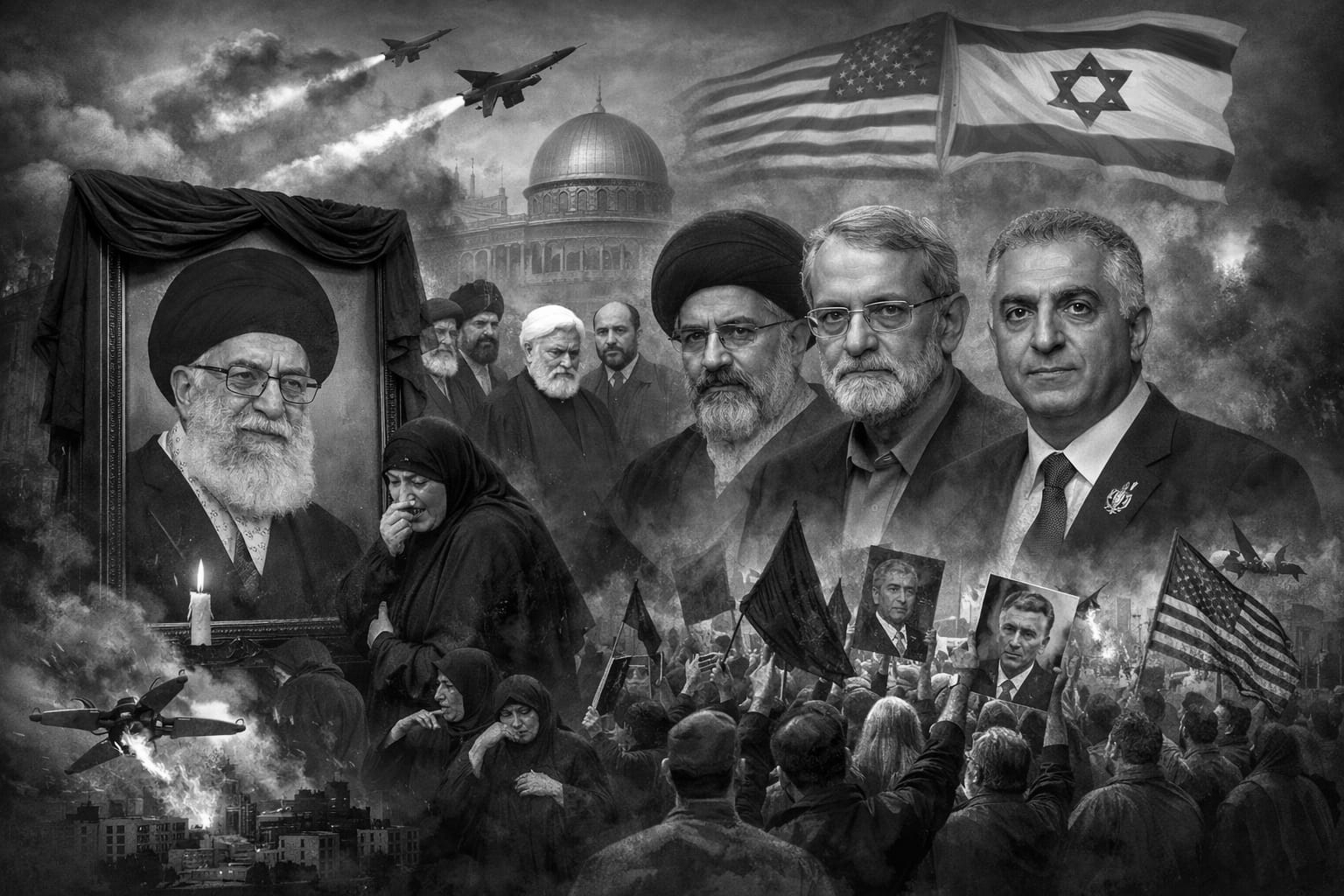
Ayatollah Ali Khamenei is no more — the succession question that will shape Iran’s future
Ayatollah Ali Khamenei is no more. Iran now faces its future without the man who shaped its politics, military, and foreign policy for nearly 37 years. Early Sunday, Iranian state media confirmed his death in coordinated U.S.–Israeli strikes, the Pentagon’s Operation Epic Fury and Israel’s Roaring Lion, calling it “martyrdom” and triggering a 40‑day national mourning period. Contrary to U.S. and Israeli claims that he was in hiding , Iranian officials stated that Khamenei had been performing his duties until the strike . His death sparked massive protests across Iran , with people taking to the streets waving black flags , burning pictures of the attackers, and demonstrating both grief and anger. The unrest also reverberated internationally, with solidarity rallies and protests erupting in several Muslim-majority countries.
Initially, Tehran denied reports, insisting Khamenei was “steadfast and performing his duties.” After Trump posted on Truth Social confirming the strike and calling him “one of the most evil people in history,” Iran acknowledged the loss. The attack killed his daughter, son‑in‑law, daughter‑in‑law, a grandchild, and roughly 40 senior officials, including IRGC commander Mohammad Pakpour, Defense Minister Nasirzadeh, and Armed Forces Chief of Staff Bagheri.
President Masoud Pezeshkian vowed revenge , calling retaliation a “legitimate duty and right,” while the IRGC promised the “most ferocious punishment.” Iran launched missiles and drones against U.S. and Israeli targets. Russian President Vladimir Putin condemned the killing as a “cynical violation of international law,” and China called the strikes “unacceptable.”
Across the Muslim world, protests erupted: in Karachi, Pakistan , demonstrators stormed the U.S. Consulate , killing at least 22; in Baghdad , crowds rallied outside the U.S. Embassy Green Zone , with smaller demonstrations in Kashmir and North Africa.
But who exactly was Ayatollah Ali Khamenei ? To understand that, you have to go back to 1939 , to the holy city of Mashhad in northeastern Iran. Khamenei was a young boy growing up in a deeply religious household. His father was a cleric, and from the earliest age, his life was shaped by both religion and politics . As a young seminarian, he joined the resistance movement against the Shah . He was arrested multiple times by the Shah’s feared secret police, SAVAK , yet he always returned to the cause. Then came 1979 . The Islamic Revolution , led by Ayatollah Ruhollah Khomeini , toppled the monarchy and reshaped Iran forever.
Khamenei became part of the new order. In 1981 , he survived an assassination attempt that left his right arm permanently paralyzed. That same year, he became president , the first cleric to hold the office, and soon found himself leading a nation at war with Saddam Hussein’s Iraq . That brutal eight-year conflict left deep scars, teaching Khamenei an enduring lesson: Iran was alone in the world . When Khomeini died in 1989 , Khamenei was elevated to Supreme Leader , a decision that surprised many. He publicly said he did not deserve the role, but his leadership would define Iran for decades. His tenure of 36 years made him the longest-serving head of state in West Asia . He turned the IRGC into a powerful military, political, and economic force , promoted a “resistance economy” to withstand sanctions, defended Iran’s right to peaceful nuclear energy , and built the Axis of Resistance , securing regional influence despite global isolation.
Ali Larijani plays a key role in implementing Khamenei’s multi-layered succession plans. An interim leadership council now governs, including President Pezeshkian, Chief Justice Mohseni‑Ejei, senior cleric Alireza Arafi, and Larijani coordinating. Potential successors include Mojtaba Khamenei , though son-to-father succession is controversial, and uncertainty remains over whether the Supreme Leader post may even be abolished . Analysts warn that if the Islamic Republic regime falls or loses central authority , another possibility is that Reza Pahlavi, son of the last Shah of Iran, Mohammad Reza Pahlavi, could attempt a return , potentially serving as a proxy for U.S. and Israeli interests , further complicating Iran’s political future.